


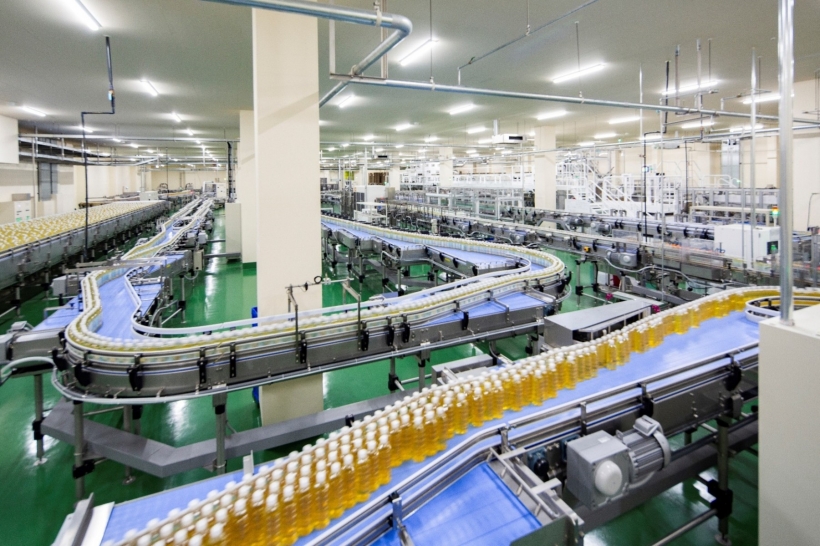
Wakayama Nokyo Foods, a leading beverage manufacturer in Japan, produces 700 million bottles of beverage every year. The premium Orwak balers 5070-HDC, introduced by Orwak Japan at the manufacturing sites, help solving the waste management challenges related to discarded PET bottles and improve the operational efficiency.
700 million beverage bottles per year
Wakayama Nokyo Foods Industry has been a pioneer in the beverage industry in Japan since the 1970s, when it started producing beverages and processed foods utilizing the abundant agricultural products, such as plums and mandarins, in the Wakayama region. It was the first company in Japan to introduce an aseptic filling PET bottle line. Through proactive capital investment and continuous technological development, the company has been improving and innovating both its production system and quality, and it has resulted in one of the highest beverage production volumes in Japan. The wide variety of products can be found in convenience stores and supermarkets all over the company.
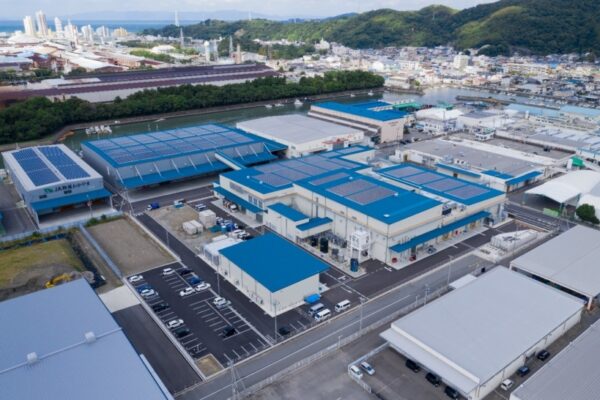
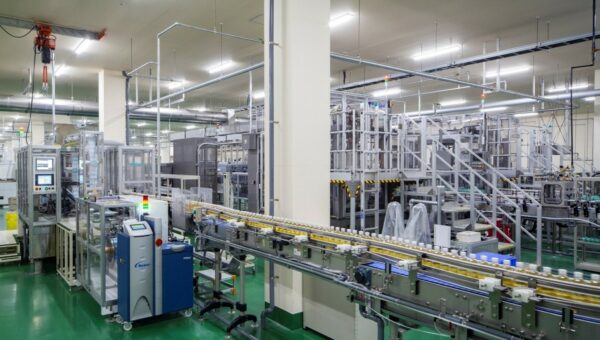
Currently, Wakayama Nokyo Foods Industry operates four factories in the region. The Hainan Plant produces approximately 36 million cases, or about 700 million pcs of PET bottles filled with beverages, annually. The production line operates at high speed, almost 24 hours a day, to meet demand throughout Japan. However, the beverage production process generates a large amount of discarded PET bottles. Storing and disposing of them as they are would not only strain factory space but also directly increase industrial waste disposal costs. Therefore, efficiently and safely reducing the volume and storing discarded PET bottles has become a critical challenge on site.
Orwak balers play a vital role behind the scenes
To address these challenges, they invested in Orwak’s multi-chamber vertical baler 5070-HDC supplied by Orwak Japan. The same model is also used in the Chiba factory. “HDC” in the model designation stands for “Heavy Duty, Cross-binding”, which are excellent product features for bottle compaction, since PET is a tough material to compact and requires the strong compaction of a heavy duty baler and the cross-binding function provides a tight grip of the PET bale preventing flattened bottles from falling apart.
Furthermore, Wakayama Nokyo Foods obtained ISO9001 and FSSC22000 (international certification standards for food safety management systems), and through a consistent inspection system from raw material acceptance to shipment, and on-site improvements through its unique quality control activity, the “PACO Movement,” it pursues a high level of safety and security in the production at all of its factories. In line with this, it is natural to carefully choose premium quality equipment that fulfils high safety standards.
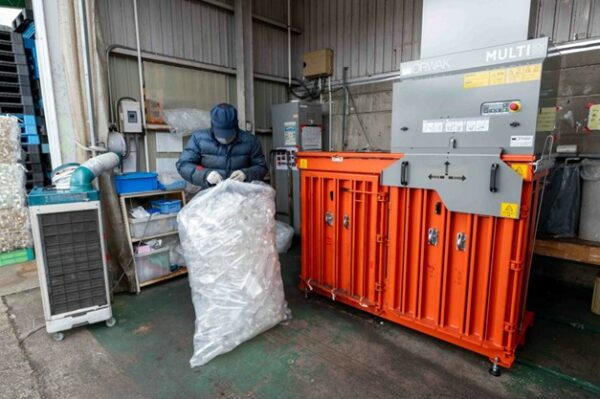
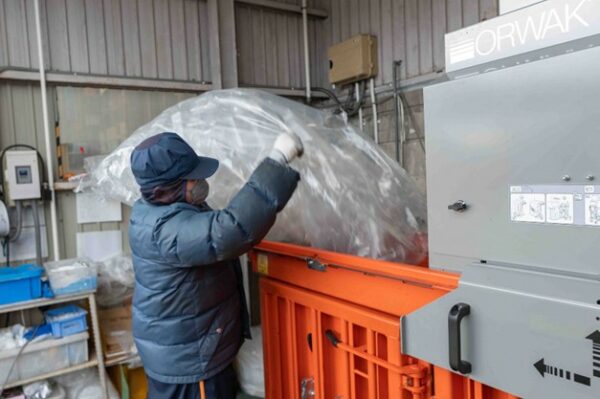
The baler is top-loaded, which facilitates the bottle loading
New generation effective balers
The current equipment, introduced in 2025 by Orwak Japan’s sales team, is the second generation, replacing the aging first-generation balers installed in 2009. When considering the replacement, the model 5070-HDC was selected based on safety, work efficiency, and reduction of environmental impact. After the replacement, the onsite staff gave positive feedback: “The compaction speed has been optimized, allowing for a faster pace of work than before,” and “The bales are very stable and perfectly square-shaped, which makes stacking on pallets easier and safer.”
Additionally, due to the increase in production volume at the Kainan factory, the compaction processing volume in 2025 increased by approximately 1.7 times compared to the previous year. However, thanks to the dedicated work of the assigned staff, the increased volume is being handled without delay.
Tangible advantages and operational effectiveness in figures
Processing volume and collection conditions
- Processing volume: Approximately 9-13 bales per day
- Monthly collection volume: 5,500 kg/month on average
- Collection frequency: Once a month using a 10-ton wing truck
Increased storage capacity
- Pallet dimensions: 1100mm x 1100mm = 1.21 m²/pallet
- Loading conditions: 4 bales x 3 layers per pallet = 12 bales
- Estimated storage space: Approximately 6 m² ÷ 1.21 m² ≈ 4.95 pallets
- Estimated actual operational capacity: 5 pallets
- Quantity that can be stored: 12 bales x 5 pallets = Approximately 60 bales
- PET bottles are compacted to approximately 1/6 of their original size
- Storage capacity increased 5 to 6 times (maximum storage capacity: equivalent to approximately 1,800 kg of PET bottles)
Reduced costs during collection and transportation
- Improved transportation efficiency
Reduced workload
- The compact and lightweight bales (about 30 kg) can be handled by one person, resulting in improved safety and reduced workload
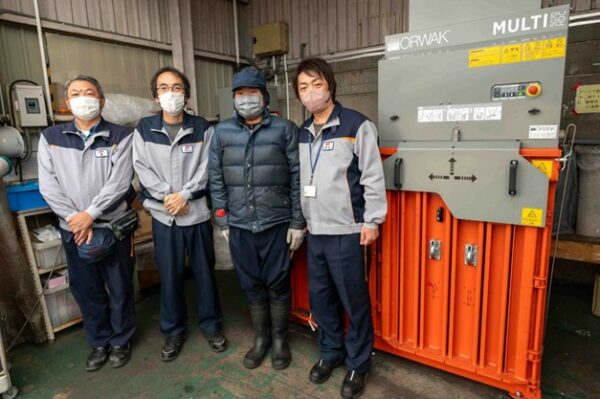
A decicated team: Mr. Enoki, Mr. Niiyama, Mr. Hayashi, and Factory Manager Yabuta
More sustainable beverage production attained
Wakayama Nokyo Foods Co., Ltd. has achieved sustainable beverage production by combining its advanced technological capabilities, exemplified by the introduction of Japan’s first PET bottle beverage and aseptic filling PET bottle line, with environmental technologies such as solar power generation, cogeneration, and biomass boilers.
- Stable supply of safe and secure beverages
- Waste reduction and resource recycling
- Challenges toward achieving carbon neutrality
Orwak Japan is honored that the 5070-HDC balers support these sustainability initiatives: “We will continue to provide environmentally friendly solutions by creating workplaces that “never stop,” “never accumulate,” and “never waste,” together with our customers, including beverage and food factories.”
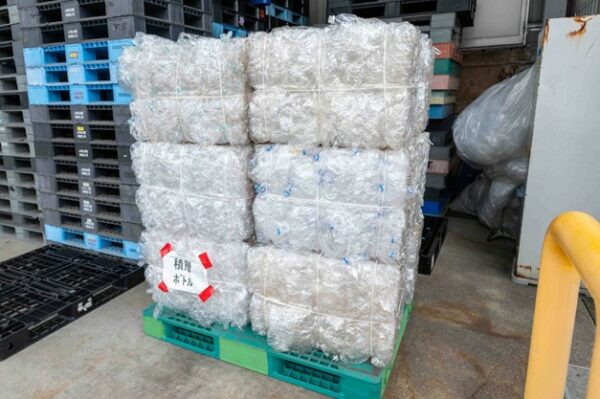
Neat PET bales stacked for collection
What happens to PET bottles after they are collected?
Typically, PET bottles collected in Japan are recycled in various ways depending on their use and quality. One method that is attracting attention is “horizontal recycling,” which returns used bottles to beverage bottles. While this requires advanced sorting and washing technology, it is considered the most ideal method from a resource circulation perspective. Meanwhile, “cascade recycling,” which transforms PET bottles into other products such as fibers and sheets, and “chemical recycling,” which chemically decomposes them back into raw materials, are also important options. By appropriately combining these methods, progress is being made towards realizing a circular economy that maximizes the resource value of PET bottles.
Horizontal Recycling Spreads in the Beverage Industry
In recent years, the beverage industry has seen a rapid increase in “horizontal recycling,” which involves recycling used PET bottles back into new PET bottles. Unlike traditional recycling for textiles and other uses, this method significantly contributes to reducing the use of petroleum-derived raw materials and CO₂ emissions by circulating resources for the same purpose. Major beverage manufacturers in particular are investing in advanced technologies at each stage of collection, sorting, and recycling, and collaboration across the entire supply chain is being strengthened. Horizontal recycling is becoming the new standard in the beverage industry as it contributes to the realization of a circular economy.
Image source: Orwak Japan